
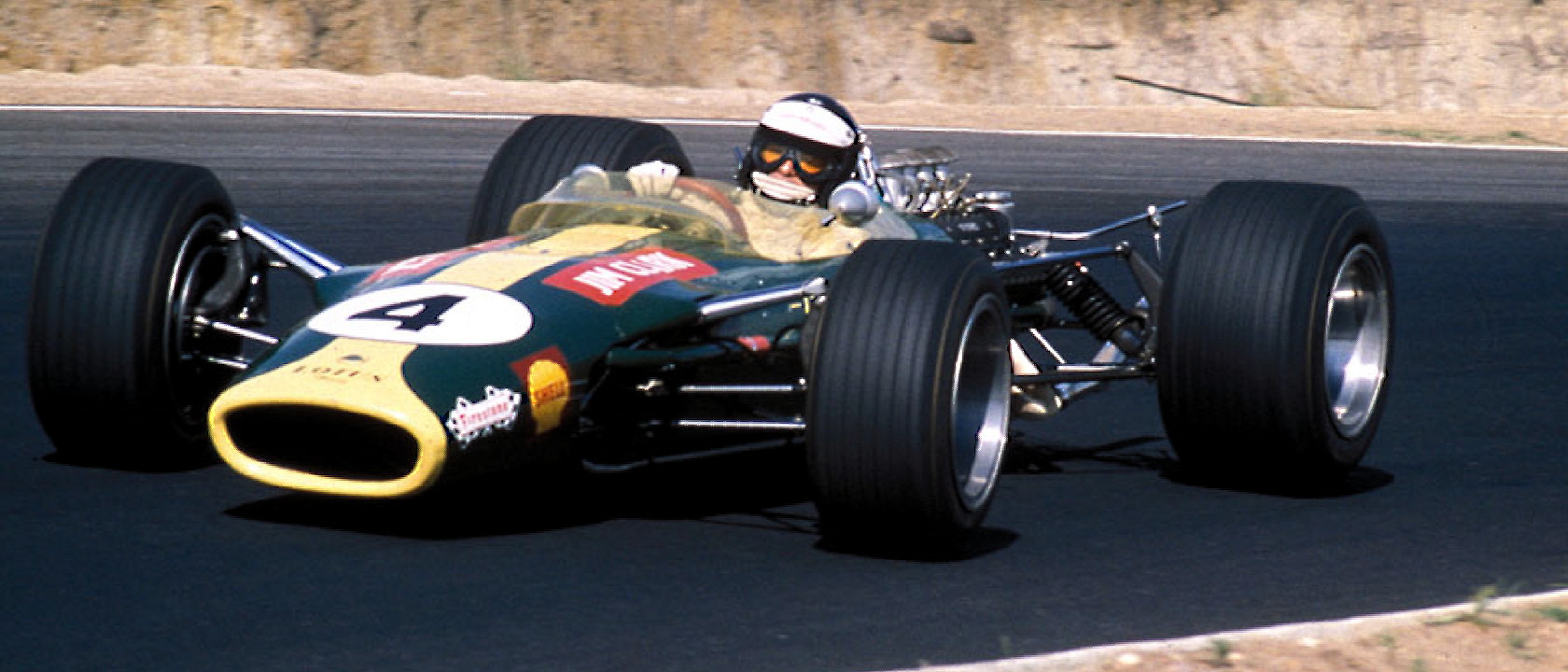


Lotus 49 Cosworth 1967
In the highly competitive arena of motor sport, only once in a while does a real driving genius emerge from the pack. One such man was Jim Clark. Scotsman Clark drove his entire F1 career for Colin Chapman’s Team Lotus, winning two Formula One World Championships and the 1965 Indianapolis 500. Jimmy may have been the most naturally talented driver to have graced the Formula One stage. A personal favorite, Clark remains one of the all-time best statistically 50 years after his death. His total of 25 career GP wins broke the record set by the legendary Juan Manuel Fangio, and in the many decades since has been surpassed only by eight drivers (Jackie Stewart, Nigel Mansell, Alain Prost, Michael Schumacher, Aryton Senna, Fernando Alonso, Sebastian Vettel and Lewis Hamilton), all of whom benefited from a much longer Grand Prix season.

After an initial controversy at Monza in 1961, where he was involved in a gruesome accident that claimed the life of Wolfgang von Trips, giving the World Championship to American Phil Hill and his famous shark-nosed Ferrari 156, Clark barely lost the 1962 title to Graham Hill (then driving for BRM — “British Racing Motors” — but later a Lotus teammate) when an oil leak caused a DNF while leading the final race (and the season points) at Prince George’s in South Africa. He won handily in 1963, and repeated in 1965, scoring the maximum possible championship points in both seasons — in those days, of course, only a predetermined number of race classifications counted to the F1 World Championship. All this despite taking May off each year, and missing Monaco, to compete in and become the first Briton to win at the Brickyard. The Clark-driven Lotus was mostly only ever beaten when the mechanical side of the equation failed to deliver. The action photo below is from the 1967 Dutch Grand Prix at Zandvoort, which Clark won in the revolutionary Lotus 49 with the then-new Ford Cosworth DFV 3.0 V8 engine — the power plant that would go on to dominate Formula One for nearly two decades.
Clark won the opening race of the 1968 season in South Africa, where the first sponsorship-liveried F1 car was unveiled for “Gold Leaf Lotus” by Chapman, but died on 7 April 1968 during an inconsequential F2 race at Hockenheim, Germany, in an accident that to this day remains largely unexplained, when his Lotus left the track and crashed into nearby trees. A small plaque — now located behind a protective Armco guardrail — is set in the trees to mark the spot of his tragic death. Even more sadly, the Hockenheimring was reconfigured in 2001 to take away its classic long straights through the forest and then dropped as the
After all, Jim Clark was the best of the best.
— Ayrton Senna —


home of the German Grand Prix in favor of an equally emasculated Nürburgring, making that small monument itself now a part of F1 history.

Jim Clark was an intuitive racer, competing in all classes and disciplines — saying that when he needed to go faster, he would not drive any faster, rather “concentrate harder.” He won four straight Belgian GPs at the tremendously difficult Spa-Francorchamps circuit, a track he despised, and was masterful in wet conditions. His dominant 1965 season in the Lotus 33 — in which he led every lap of every race he finished —  is matched in F1 history perhaps only by the spectacular 1988 results of Prost and Senna at McLaren. But the single fact which tells the most about Clark is that only once did he finish second; in other words, if Jim made it to the flag, he invariably made it before anyone else, typically running away into the lead and driving uncontested to the finish. Whether Clark, a private and soft-spoken man, would have prospered in the modern era of F1 sponsorship and downforce will never be known, but his absence ended a time of relative innocence in Formula One. As Chris Amon, then with Ferrari, said in 1968, “If it could happen to him, what chance did the rest of us have? I think we all felt that. It seemed like we’d lost our leader.”
| Jim Clark’s Career Profile | ||||||
| Seasons | Races | Wins | Poles | Fastest Laps | Points | F1 Titles |
| 9 | 72 | 25 | 33 | 28 | 274 | 2 |
Other Jim Clark Sites
Formula1.com Hall of Fame
Wikipedia Article
TimesOnline 40th Anniversary Profile
“Remember Jim Clark” by Roger Horton
Biography by Dennis David
BBC’s Greatest F1 Drivers
GP Encyclopedia
AutoSport—F1’s Greatest Drivers
ESPN F1 Profile
Hockenheim Historic Memorial
Jim Clark Video
Jim Clark—The Quiet Champion |
SpeedTV Tribute |
Murray Walker’s F1 Greats |
Thankfulness to my father who informed me concerning this weblog, this web site
is genuinely awesome.