While four teams have been most prominent in recent Formula One seasons, the sport’s seven decades witnessed both pioneering independents and massive, factory-supported “works” organizations. A look at the more influential F1 teams of history illuminates the growth of Grand Prix racing over the years from a club-like gentlemen’s pursuit to the high-profile international industry of today.

Scuderia Ferrari
Maranello, Italy
The Scuderia Ferrari (literally “Stable Ferrari”) is unique in the Grand Prix world, standing as the only team to have competed in every season of the Formula One World Championship, from its inception in 1950 to the present day. The team was founded by Enzo Ferrari, initially to race cars produced by Alfa Romeo, and statistically is the most successful F1 team in history with a record of 15 drivers’ championships and 16 constructors’ championships. The prancing horse was the symbol on Italian World War I ace Francesco Baracca’s fighter plane, and became the logo of Ferrari after the fallen ace’s parents, good friends with The Commendatore himself, asked Enzo to continue his tradition of sportsmanship, gallantry and boldness. Ferrari’s faithful and fervent fans, nicknamed the Tifosi, remain omnipresent in Formula One grandstands worldwide.
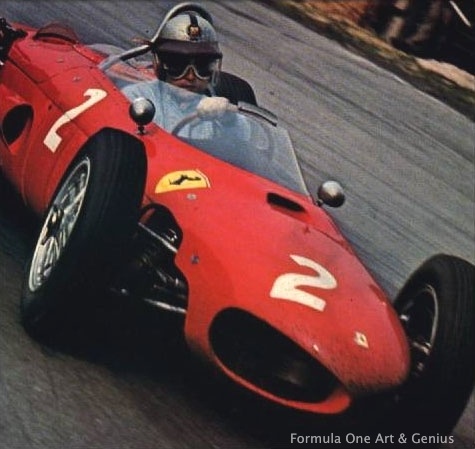
In fact the Ferrari team missed the first race of the initial Formula One championship, the 1950 British Grand Prix, due to a dispute about the “start money” paid to entrants, and debuted at the 1950 Monaco Grand Prix. Its break-out season was 1961, where the team fielded Phil Hill, Wolfgang von Trips and Ritchie Ginther driving the beautiful shark-nosed Ferrari 156, which was dominant throughout the season. Team orders have proven controversial at several points in Ferrari’s history. In 1982, at the San Marino Grand Prix, the two Ferraris were leading with Gilles Villeneuve ahead of Didier Pironi, but Villeneuve was shocked when Pironi overtook and won the race. Villeneuve’s anger at what he saw as betrayal by his teammate is often considered a major factor in his death in qualifying at the next race in Zolder, Belgium. Similar, albeit non-fatal, controversies erupted in 2002 and 2010. Ferrari has always produced engines for their own Formula One cars — winning more GPs even than the storied Ford Cosworth powerplant — and also supplies engines to other teams. In 2010 and 2011, for instance, Scuderia Toro Rosso and Sauber used Ferrari engines. Ferrari previously sold F1 engines to Minardi, Scuderia Italia SpA, Prost Grand Prix (engines badged “Acer”), Red Bull, Spyker F1 and Force India.
Ferrari holds the F1 records for most wins, most poles and most constructors Championships. It’s driver line-up has included such legends as Juan Manuel Fangio, Phil Hill, Niki Lauda, Alain Prost and Nigel Mansell, among others. It is German Michael Schumacher and team principal (now FIA chief) John Todt with whom the Scuderia had their greatest period in the early 2000s, utterly dominating the sport for six straight years. Ferrari’s history has included some bleak uncompetitive periods, but the sea of red at most GP venues today and their obvious passion proves the team’s continued central role in Formula One racing and culture. Despite the team’s periodic, petulant threats to boycott F1 or form a break-away series, the sport would be lifeless without the boys from Maranello. Official Scuderia Ferrari Site.
McLaren F1 Racing
Woking, Surrey, England
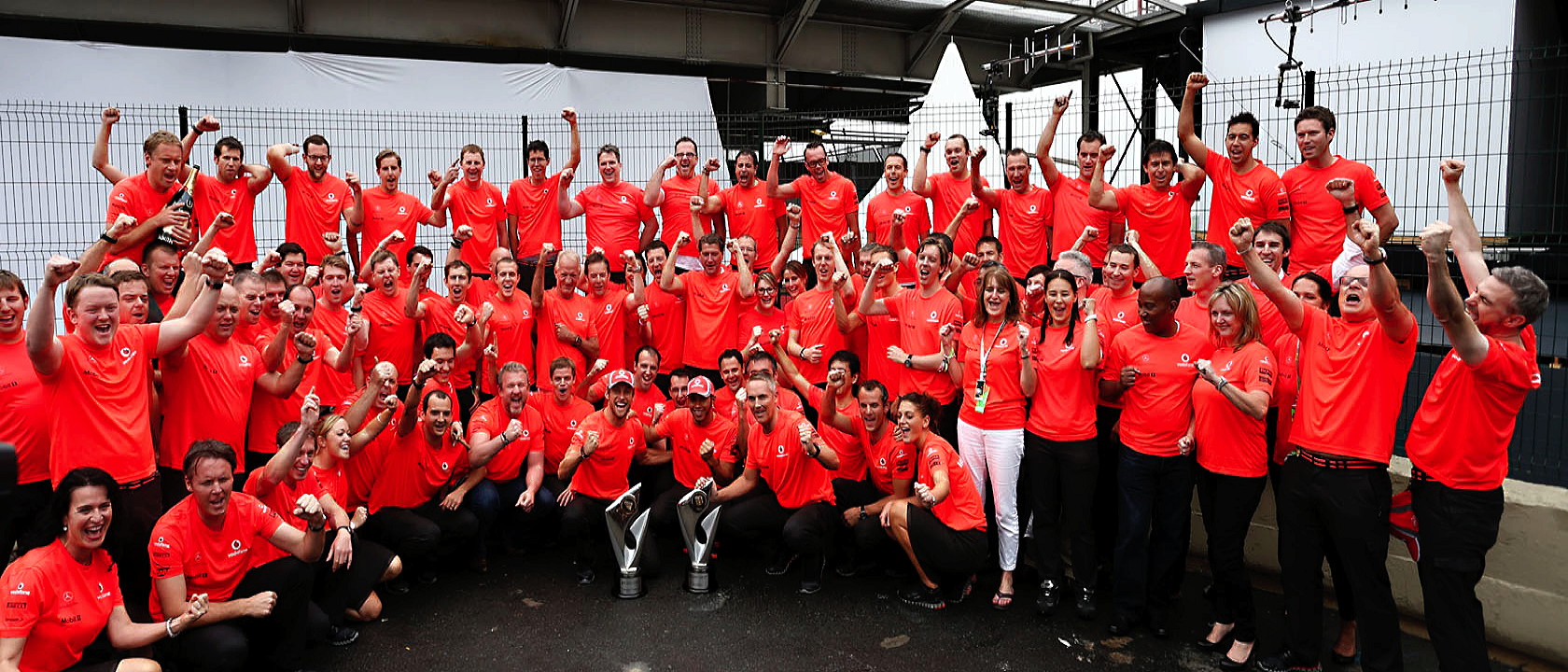
Founded by New Zealand F1 driver Bruce McLaren in 1963, and debuting at Monaco in 1966, the McLaren Formula One team has boasted a record of excellence throughout its long history. The team has won eight constructors championships and 11 drivers championships with motor sport legends such as Emerson Fittipaldi, James Hunt, Ayrton Senna — and more recently Mika Häkkinen, Nico Rosberg and Lewis Hamilton. Racing is the nerve-centre of the McLaren operation, which like Ferrari has also (on occasion) manufactured street cars, with investments in extensive design offices, wind tunnels and fabrication facilities dovetailing together to create some of the most iconic Formula 1 cars in the sport’s history. McLaren stands as the second most successful F1 team after Ferrari, with more Grand Prix wins under its belt than any constructor other than the Scuderia. The 1970s started in tragedy for McLaren as Bruce McLaren lost his life in a testing accident at Goodwood. Although the team continued his legacy it would not see another race win for two years. Finally, at the South African GP in 1972 Denny Hulme, former World Champion, recorded his first race win for McLaren since Bruce’s death.
Two years later, McLaren emerged to take center stage, with Fittipaldi driving to a World Championship. The team even managed to win the Indy 500 in the same year, duplicating the Jim Clark/Lotus feat from 1965. Its next championship GP win came in 1976 with James Hunt taking over from Fittipaldi and capturing the drivers’ championship. By the 1980s McLaren was in top form. The team merged with Ron Dennis’ Formula 2 team to form the current McLaren F1 Racing team and they began an unparalleled dominance of Formula one. A succession of top drivers over the next few years, the likes of Niki Lauda, Alain Prost and Senna, brought great results with McLaren taking championships in 1984, 1985, 1988 and 1989. Teammates Senna and Prost achieved the highest number of race wins of any pair in F1, notching up 14 between them in 1988 and 1989. The winning combination of Senna & Prost together with a class-leading new Honda engine meant that not only did they win all but one race in 1988, they also led all but 27 laps of the season, a record still unbeaten today. Official McLaren F1 Site.
Red Bull Racing
Milton Keynes, England, UK
An Austrian team based in Buckinghamshire County northwest of London, Red Bull Racing was formed from the remnants of Jackie Stewart’s successful upstart Stewart Grand Prix, which itself was followed by the dismally unsuccessful Jaguar Racing. Along with Scuderia Toro Rosso, it is one of two F1 teams owned by beverage company Red Bull GmbH. (Red Bull’s involvement in Formula One dates back to 1995, when it first sponsored the Sauber team.) The energy drink firm purchased Jaguar’s assets in November 2004, acquiring the keys to a factory, a core team of staff and the early specifications for a car that would become the RB1. Christian Horner was recruited from F3000 to become team principal, while David Coulthard was hired to lead the team on the track. In that first season the second car was shared by two young sponsored drivers, Austria’s Christian Klien and Italian rookie Vitantonio Liuzzi. The new outfit made its competitive debut at the 2005 Australian GP, with both Cosworth-powered cars coming home in the points. The team went on to finish 7th in the Constructors’ Championship. But greater things were ahead for Red Bull, as a change to Ferrari engines for 2006 saw the RB2 take the team to its first podium finish, thanks to a faultless drive from Coulthard at the Monaco GP. Team boss Horner said before Monaco that if one of his cars were to finish on the podium, he would jump into the swimming pool at the circuit naked. He ended up plunging into the la piscine wearing only a red cape. Coincidentally, both Stewart GP and Jaguar, the team’s predecessors, had scored their maiden podiums on the streets of Monte Carlo.
Off track, Red Bull’s technical team was growing, engineers and mechanics with championship pedigree experience were recruited, among them famed designer Adrian Newey. The new technical chief had a reputation for innovation and six Constructors’ Championship titles to back it up; having taken both Williams and McLaren to the heady heights of multiple titles in the 1990s, Newey’s challenge was to do the same for a young team determined to challenge the status quo at every opportunity. Six short seasons into Red Bull’s F1 adventure Newey delivered, ensuring the team’s first victory was crowned with a 1-2 finish. Seizing on major regulation changes for the 2009 season, the designer penned a spectacular car that took six wins on its way to second behind the equally radical Brawn GP driven by Jenson Button. That innovative design — accompanied, as always, by controversy over things like blown diffusers — paved the way for Sebastian Vettel’s remarkable back-to-back World Championships, now powered by Renault, in 2010 and 2011. With a brilliant 16 season pole positions (including 12 straight) and a massive points lead, Red Bull Racing’s dominant 2011 performance exceeded even the memorable years of McLaren in 1988-89 and Williams in 1992-93. Having now scored consecutive Constructors’ titles, Red Bull continues as of this writing to keep its more established Formula One rivals decisively behind on the grid. Official Red Bull Racing Site.
Williams GP Engineering
Grove, Oxfordshire, England
Williams Grand Prix Engineering Ltd., now trading as Williams F1 and competing as Williams Martini Racing, was founded in 1977 by Sir Frank Williams and Patrick Head. The Williams team’s first race was the 1977 Spanish GP, where the new organization ran a March chassis for Patrick Neve. Williams started manufacturing its own cars the following year — designed by Head and financed by a portfolio of Saudi sponsors recruited by Frank Williams — and Switzerland’s Clay Regazzoni won Williams’ first race at the 1979 British Grand Prix.  In 1980, Alan Jones became the first of seven Williams’ drivers to win the F1 Drivers’ World Championship, 17 points ahead of Nelson Piquet’s Brabham. Williams also won its first Constructors’ Championship, scoring almost twice as many as points second-placed Ligier. Later, led by Head’s pioneering design work with active suspension in the 1990s, the Williams team produced some of the most exotic and fastest F1 racing cars of all time. These culminated in the FW14B and FW15, each of which captured dominant Drivers’ and Constructors’ Championships in 1992 and 1993. Despite that technical brilliance, Williams has languished as a mid-pack team for most of the last decade, its last title claimed by Canadian Jacques Villeneuve in 1997.
Prior to the 1985 season, Frank Williams was involved in a road accident while returning from a test session at Paul Ricard circuit in France. He suffered a broken neck and would thereafter be confined to a wheelchair, while maintaining his classic British demeanor. At the 1997 British Grand Prix, Villeneuve won the team’s 100th race, making Williams one of only three teams in Formula One, alongside Ferrari and McLaren, to take the laurels in 100 races. Williams won nine Constructors’ titles in a mere 18 years (1980 to 1997), which stood as a all-time F1 record until surpassed by Ferrari in 2000. Many famous racing drivers have driven for Williams, including Jones, Finland’s Keke Rosberg, Britain’s Nigel Mansell, Damon Hill and Jenson Button, France’s Alain Prost, Brazil’s Nelson Piquet and Ayrton Senna, and Villeneuve — all of whom, with the exception of Senna and Button, captured one driving title with the team. After Williams secured the signing of Senna in 1994, Prost retired rather than partner again with his greatest rival, as Prost’s contract prohibiting the hiring of Senna covered only 1993. After Senna tragically died in a Williams car during the San Marino GP at Imola, Italy, Frank Williams, Head and chief designer Adrian Newey were all — ridiculously — accused of manslaughter. The trial finally closed in April 2007; although found responsible for Senna’s accident, Patrick Head was not arrested because the final verdict was issued after the statute of limitations had expired. Nonetheless, Williams in 2011 became the first Formula One constructor to undertake an Initial Public Offering (“flotation” in the UK), and is still the only publicly traded F1 organization. Official Williams F1 Site.
Team Lotus
Hethel, Norfolk, England
Formed initially as Lotus Engineering Ltd. by now-famed engineer Colin Chapman in 1952, Team Lotus was soon split off and stands as one of the most successful F1 organizations of all time — remaining 4th in both GP wins and constructors’ championships even to this day. Lotus was active in Grand Prix racing from 1958 to 1994, winning seven Formula One constructors’ titles, six drivers’ World Championships and the Indianapolis 500 twice in its glory years between 1962 and 1978. The team ran cars in many motorsport series including F1, Formula Two, Formula Ford, Formula Junior, USAC (IndyCar) and sports car racing, and was responsible for a number of crucial innovations in motorsport, in both technical and commercial arenas. Team Lotus, for instance, first brought non-automotive sponsorship — discarding national racing colors — and commercial livery to F1 in 1968. Lotus drivers over the years included such luminaries as Sterling Moss, Jim Clark, Graham Hill, Jochen Rindt, Emerson Fittipaldi, Ayrton Senna, Nigel Mansell, Nelson Piquet, Mika Häkkinen and Alex Zanardi (among others), champions all but two.
Lotus is credited with making the mid-engined layout popular for IndyCars, developing the first monocoque F1 chassis, and the integration of the engine and transaxle as chassis components. Lotus was also among the pioneers in Formula One in adding wings and shaping the undersurface of the car to create downforce, as well as the first to move radiators to the sides of the car to aid aerodynamic performance, and invented computer-controlled “active” suspension. Chapman’s quest for lightness at the cost of structural rigidity, however, has been criticized as contributing to the dark cloud of death that hung over the sport in the ’60s and ’70s. Even after Chapman’s own premature heart attack passing at age 54 in 1982, Lotus continued to be a major player in Formula One well until the late 1980s. Ayrton Senna drove for Team Lotus from 1985-87, winning twice in each season and posting 17 pole positions. However, the team’s last F1 race was in 1994, when the cars were no longer competitive, the organization demoted essentially to a backmarker and shortly thereafter dissolving into bankruptcy. Lotus won a total of 79 Grands Prix. During his own lifetime, Chapman saw Lotus overtake Ferrari as the first F1 team to achieve 50 GP victories, despite Ferrari having won their first nine years sooner. In 2010, the Team Lotus brand was reincarnated after more than a decade away from Formula One as a Malaysian-owned outfit running classic British racing green and yellow livery. But then in 2011, Renault F1 (in turn, formerly Benetton, where Michael Schumacher won his first two World Championships) was re-christened Lotus-Renault, running with virtually the same, black “JPS Lotus” colors in which Mario Andretti won the 1978 World Championship — leading to the thoroughly confusing spectacle of two teams with the Lotus moniker in the Formula One paddock. That’s now been settled — the current Lotus F1 Team races on, still clad in distinctive black and gold, led in 2013 by Kimi Räikkönen. And they’re doing rather well. Classic Team Lotus Site.
Cooper Car Company
Surbiton, Surrey, England
Through the 1950s and early 1960s, the small auto racing team formed by Charles Cooper and his son in their English garage reached motor sports’ highest levels as their rear-engined, single-seat machines forever altered the face of both Formula One and the Indianapolis 500, revolutionizing race car engineering and ushering in an era in which handling mattered far more than raw horsepower. Jack Brabham raised some eyebrows when he took sixth place at the 1957 Monaco Grand Prix in a rear-engined Formula 2 Cooper. When Stirling Moss won the 1958 Argentine Grand Prix in Rob Walker’s privately-entered, underpowered blue Cooper T45, a car that gave away almost half a liter to its rivals, the race promoters at first refused to pay up,  saying the “funny little” car did not look like a proper Grand Prix machine. After Maurice Trintignant duplicated the feat the very next GP at Monaco, the racing world was stunned and a rear-engined revolution had begun. In 1959, Brabham and the Cooper works team became the first to win the F1 World Championship in a rear-engined car. Both team and driver repeated in 1960 using their own Cooper-Climax engine (with the World Championship sealed when teammate Bruce McLaren became the then-youngest winner of a Grand Prix, age 22, at Sebring). Every World Champion since has been sitting in front of his engine.
It took a few years, but the Indianapolis establishment also gradually realized the writing was on the wall and the days of their front-engined roadsters were numbered. Beginning with Jim Clark, who piloted a rear-engined Lotus in 1965, every winner of the Indy 500 has had the engine in the back. The revolution begun nearly a decade before by a little chain-driven, 500cc Cooper Formula 3 car was now complete. Once other F1 constructors began building rear-engined race cars, however, the practicality and intelligent construction of Cooper’s single-seaters was overtaken by more sophisticated technology from Lotus, BRM and Ferrari. Cooper fought back with a monocoque chassis in 1966, but its Maserati and then its BRM engines were not competitive. The Cooper team’s decline accelerated when John Cooper was seriously injured in a road accident in 1963 (driving a twin-engined Mini Cooper). After the death of his father, Cooper sold the team to Chipstead Motor Group in April 1965. Cooper Racing’s final F1 victory was achieved by Mexican driver Pedro Rodríguez at the 1967 South African GP in a Cooper T81. In all, Coopers participated in 129 Formula One World Championship events in nine years, winning 16 races. And the Cooper name continues in the automobile world thanks to the Mini Cooper, a popular road (and former rally) car now manufactured by BMW. GrandPrix History Cooper Profile.



 for two years. Finally, at the South African GP in 1972 Denny Hulme, former World Champion, recorded his first race win for McLaren since Bruce’s death.
 But greater things were ahead for Red Bull, as a change to Ferrari engines for 2006 saw the RB2 take the team to its first podium finish, thanks to a faultless drive from Coulthard at the Monaco GP. Team boss Horner said before Monaco that if one of his cars were to finish on the podium, he would jump into the swimming pool at the circuit naked. He ended up plunging into the la piscine wearing only a red cape. Coincidentally, both Stewart GP and Jaguar, the team’s predecessors, had scored their maiden podiums on the streets of Monte Carlo.
 In 1980, Alan Jones became the first of seven Williams’ drivers to win the F1 Drivers’ World Championship, 17 points ahead of Nelson Piquet’s Brabham. Williams also won its first Constructors’ Championship, scoring almost twice as many as points second-placed Ligier. Later, led by Head’s pioneering design work with active suspension in the 1990s, the Williams team produced some of the most exotic and fastest F1 racing cars of all time. These culminated in the FW14B and FW15, each of which captured dominant Drivers’ and Constructors’ Championships in 1992 and 1993. Despite that technical brilliance, Williams has languished as a mid-pack team for most of the last decade, its last title claimed by Canadian Jacques Villeneuve in 1997.
 saying the “funny little” car did not look like a proper Grand Prix machine. After Maurice Trintignant duplicated the feat the very next GP at Monaco, the racing world was stunned and a rear-engined revolution had begun. In 1959, Brabham and the Cooper works team became the first to win the F1 World Championship in a rear-engined car. Both team and driver repeated in 1960 using their own Cooper-Climax engine (with the World Championship sealed when teammate Bruce McLaren became the then-youngest winner of a Grand Prix, age 22, at Sebring). Every World Champion since has been sitting in front of his engine.




5 Replies to “Teams”
Comments are closed.