
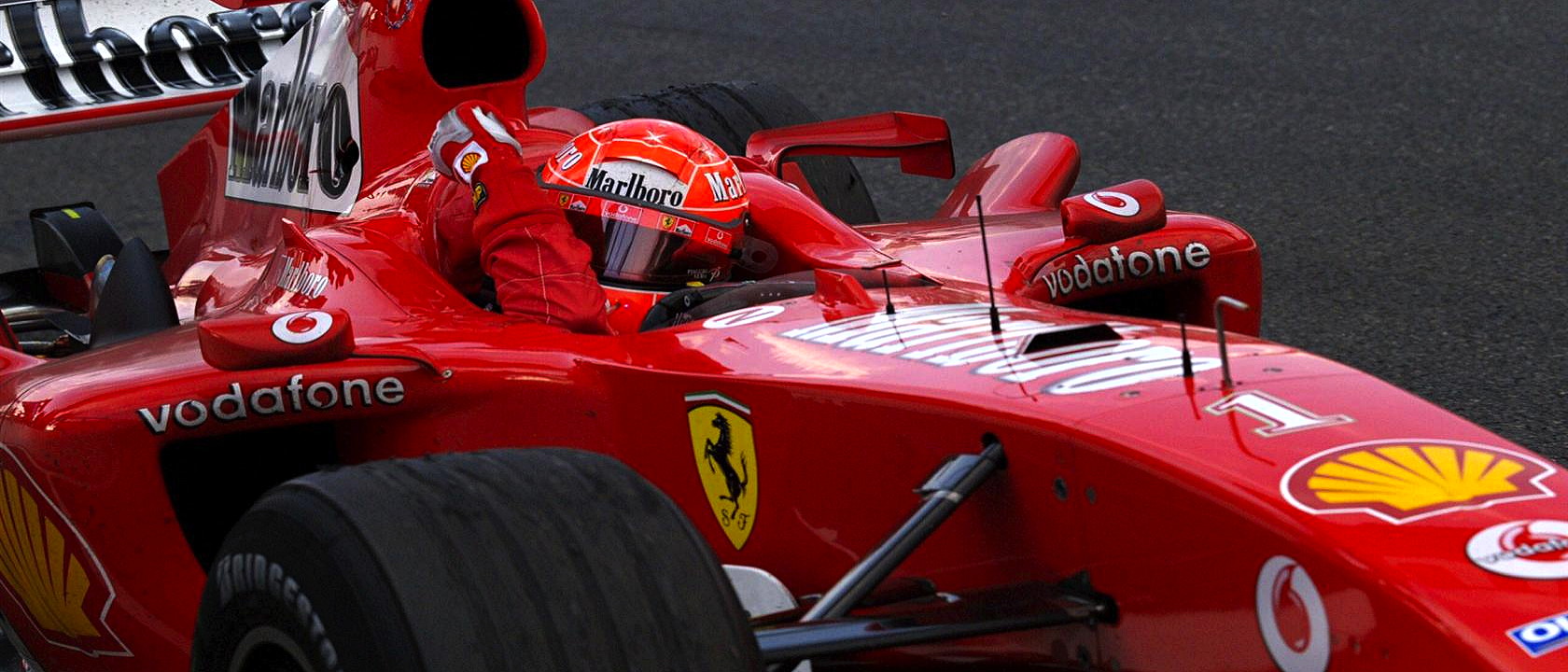


Ferrari 248F1 2006
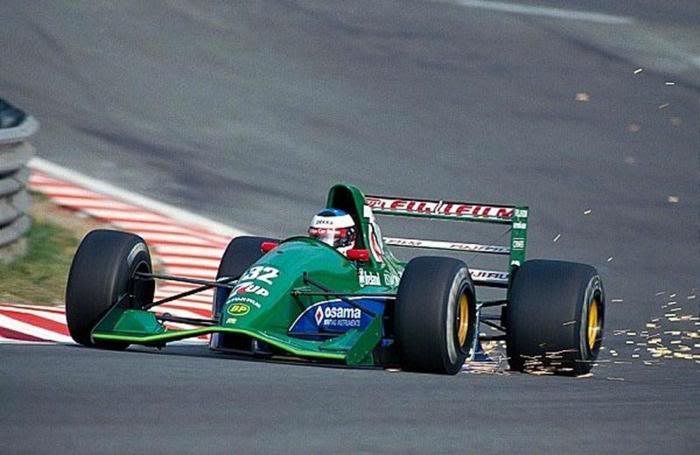
Michael Schumacher, whose transcendent career prospered alongside controversy and drama, started as one of the youngest two-time champions in Formula One history. Michael literally burst onto the F1 scene at Spa-Francorchamps in 1991, where he qualified 7th for the Belgium GP in his first start for Jordan Grand Prix. He moved on (after now-typical secretive manuverings) just one race later to Team Benetton, where his career exploded, making him the winningest F1 driver and without a serious rival — despite the 1998-99 resurgence of McLaren’s Mika Häkkinen — after the death of Aryton Senna in May 1994.

In the transformed environment of Formula One following Senna’s shocking accident while leading in a Williams at Imola — itself coming only one day after another driver was killed in practice, the 1st in a decade — Schumacher blossomed. He became the absolute center of the F1 circus for more than a decade, starting with back-to-back titles for Betentton-Renault in 1994 and 1995. An astounding seven championships later, together with a long and close partnership with designer and master strategist Ross Brawn at Ferrari, it is still quite difficult to know whether Schumacher was so much better or if the competition was so much worse.
Regardless, he was extraordinary in many ways and excelled beyond what most thought impossible in overtaking legendary Juan Manuel Fangio’s five F1 titles. The signs were there early and were quite lavishly rewarded. In a metaphor for the impressive financial rewards generated by the Formula One series under Grand Prix impresario Bernie Ecclestone’s management, Schumacher joined Ferrari for the 1996 season and signed the then-largest single season contract in racing, or perhaps sports, in history: $27 million per year. (Schumacher promptly moved, naturally, to tax-free Monaco.) Yet, the investment paid off quickly for the prancing horse team, with Schumacher claiming four poles and three wins, including the Italian GP at Monza, giving Ferrari in 1996 its best season in years.
Then came an odd interlude. In 1997, “Schumi” came within one race of taking his third F1 crown, but in a much-debated move shunted into eventual world champion Villeneuve in the final GP while attempting a daring (and later deemed unlawful) overtaking maneuver at Jerez. He kept his season points, but was stripped of his 2nd place in the World Championship by the FIA, and subsequently apologized for a lack of sportsmanship.
Every year we find something new, we go faster, and that’s what Formula One is about.
— Michael Schumacher (2002) —

The next season witnessed a thrilling, come-from-behind battle with Häkkinen that, once again, went down to the last race, where Schumacher uncharacteristically stalled on the grid, after taking pole, and decisively lost the championship when a rear tire exploded in mid-race. In 1999 Schumacher made another unforced error, this time at Silverstone in the British GP, sliding off under full wheel lock into a tire barrier, a shunt that broke his leg and ended the German’s championship hopes for the season. Still, Schumacher ruled the Scuderia Ferrari with an iron will and determination, and in the 2000 season at long last brought Maranello its first World Championship since Jody Schechter in 1979.
That was the start of what rightfully deserves to be called The Schumacher Era. Repeating again in a dominant 2001 season with Ferrari, in which he passed Alain Prost with 53 career GP victories, Schumacher elicited strong emotions, both love and hatred, from Formula One fans. He dominated the new century with a winning streak that literally rewrote the F1 record book — five consecutive World Championships and seven overall, while shattering almost all other career stats. To put Michael’s Schumacher’s incredible career in context, all one needs is these numbers: 7, 68, 77, 91, 1566. They are, respectively, the number of World Championships, pole positions, fastest laps, Grand Prix victories and points scored. All records, by a wide margin, over anyone else, ever. Schumacher may or may not have been the best driver in Formula One history. There is no denying he was the most successful. Michael dominated his Scuderia Ferrari, and the entire sport, so thoroughly that an entire generation of race drivers had only ever known Schumacher himself as world driving champion.

Schumi was masterful at using “hot” in-laps, just before pitting, to overtake a rival tactically. But he never pulled away from confrontation on the track, either. Ecclestone raved, “Michael Schumacher is a racer and it’s a pity we’ve not got more like him. Like guys such as Ayrton Senna and Nigel Mansell, he’s prepared to take a few risks. F1 doesn’t need drivers who pussyfoot around; we want them racing.” Schumacher had a visible emotional side, as well, crying at the post-race official FIA press conference after breaking the late Aryton Senna’s record for most career victories and his signature, exuberant podium jump after winning a GP race. Late in his career, a 42-year old Schumacher, after a three-year retirement, enjoyed a comeback with Mercedes — itself back in F1 as a constructor for the first time in more than 50 years. The ill-fated venture resulted in a meager one podium, a single pole (erased due to a grid-spot penalty from the prior race) and one fastest lap over three seasons, but illustrates the now very wealthy man’s love rather pure for the sport of Grand Prix motor racing. Sadly, in late 2013 Schumacher was critically injured in a freakish skiing accident, putting him in a long coma and leading to severe speech and motor disabilities that increasingly appear permanent.
The action photo of Schumacher above was taken by the author in September 2006 at the Italian Grand Prix at Monza, which Schumacher won in his last victory for Ferrari in Italy. If you look closely at Schumi’s Ferrari entering the Parabolica corner, you can see why we have named it “Victory Lap.” And clicking will reveal my second-favorite, an oldie — Michael in the B195 Benetton at the (Loewe’s) Hairpin from Monaco 1995.
| Michael Schumacher’s Career Profile | ||||||
| Seasons | Races | Wins | Poles | Fastest Laps | Points | F1 Titles |
| 22 | 306 | 91 | 68 | 77 | 1,566 | 7 |
Other Michael Schumacher Sites
Formula1.com Hall of Fame
Wikipedia Article
Biography by Dennis David
BBC’s Greatest F1 Drivers
GP Encyclopedia
AutoSport—F1’s Greatest Drivers
ESPN F1 Profile
Official Site
Michael Schumacher Video
Last Ferrari Lap |
Monaco 1996 Qualifying |
Monza 2000 Press Conf. |
2 Replies to “Michael Schumacher”