


Copyright © 1997, 2018 Glenn B. Manishin.


Motor racing after World War II initiated a new formula — originally called Formula A but soon to be known as Formula 1 — for cars of 1,500 cc supercharged and 4,500 cc unsupercharged. The minimum race distance was reduced from 500 km (311 miles) to 300 km (186 miles), allowing the Monaco Grand Prix to be re-introduced after a two-year interval in 1950. The FIA (Federation Internationale de l’Automobile) announced plans for a World Championship at a meeting held that year.  On 10 April 1950, Juan Manuel Fangio, in a Maserati, won the Pau Grand Prix, the first contest to be labeled an “International Formula One” race. A month later Silverstone hosted the British Grand Prix, the first sanctioned championship race for Formula One Grand Prix cars, and the F1 World Championship was born. Only seven of the 20 or so Formula One races that season counted towards the drivers’ title, but the championship was up and running. Even as more races were included in the World Championship, there were plenty of non-championship Formula One races as well — like Britain’s International Trophy race. (Non-championship GP races continued until 1983 when rising costs ruled them unprofitable.)
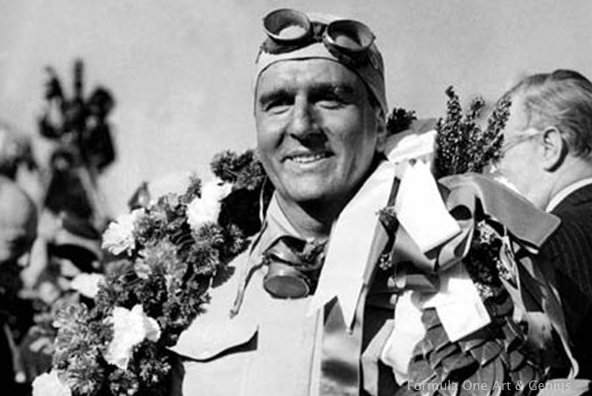
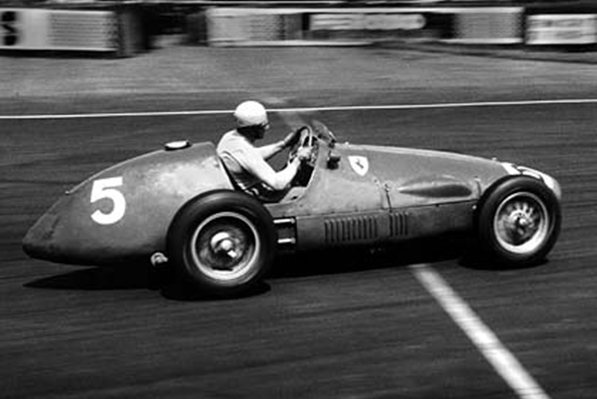
Winner at Silverstone in 1950 — adding pole position and fast lap in the process — and the first F1 champion, Giuseppe (“Nino”) Farina drove an Alfa Roméo 158, capturing the Belgium, Swiss and Italian races as well, along with non-championship wins at Bari and Donnington Park. The season continued this way with the Alfas dominating by winning all pole positions and all races. Farina was able to capture the World Championship by a slim three points because in addition to his three wins he had a 4th place finish, as opposed to Juan Manuel Fangio’s three wins and no other points-paying positions. Farina is best remembered for his style of driving; the relaxed, inclined position and outstretched arms that was to influence a whole generation of F1 pilots. In the ’50s, at the start of modern Formula One, the cars were front-engined beasts with large-displacement motors and minimal testing and design improvement. Thus even in post-war days, many of Farina’s contemporaries still sat crouched,  fighting with the wheel. Leaving for Ferrari in 1951 — the first World Championship for Juan Manuel Fangio, driving an Alfa, and the year of Scuderia Ferrari’s first official F1 win, at Silverstone, “The Pampas Bull” José Froilán González driving — for the next two seasons Farina fought a personal battle with Alberto Ascari, a battle he was bound to lose. Ascari was by far the better driver; more controlled, faster and more precise. Ascari won the F1 World Championship in 1952 and 1953 in the iconic Ferrari 500.
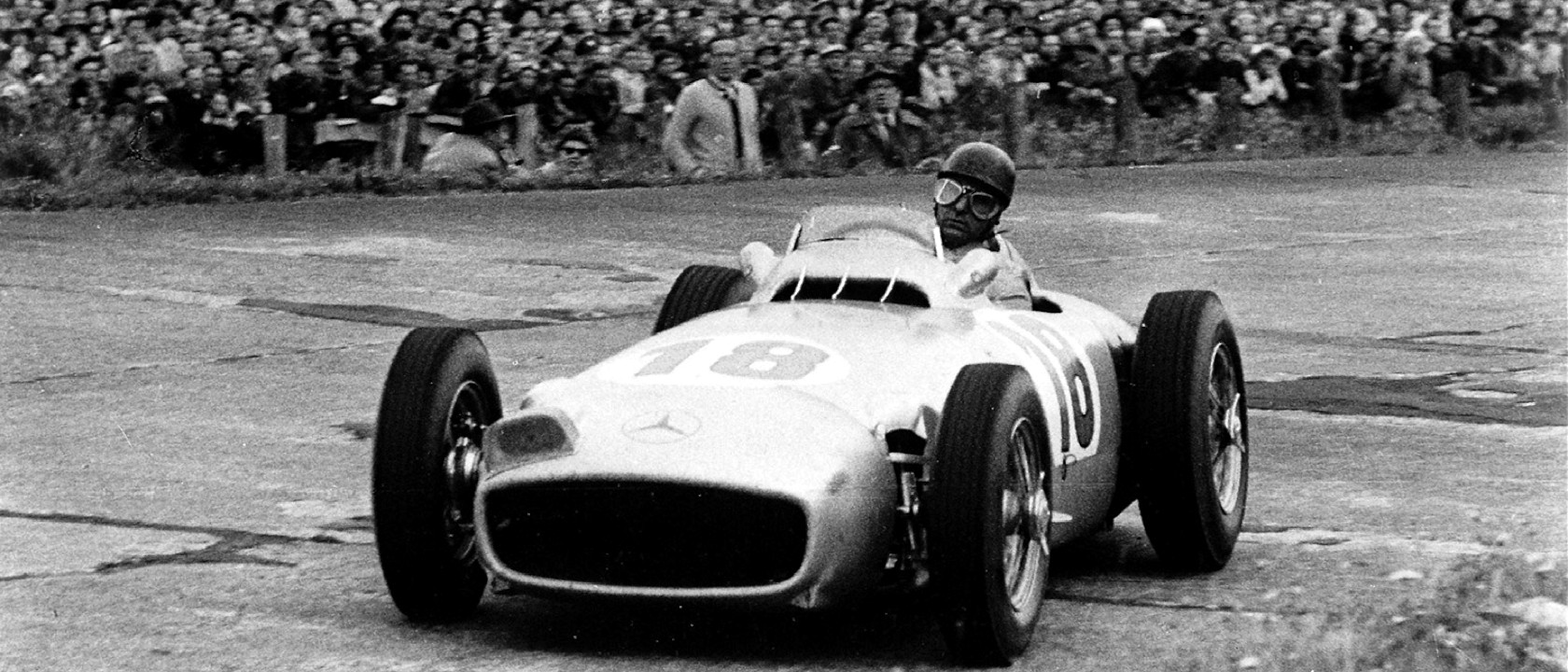
It was not an easy beginning. In those twin early years of ’52-’53, the lack of entrants meant the authorities were forced to conduct most races to Formula Two regulations. Of the 20 marques that competed in 1950, a large number were soon forced out by cost.  Nonetheless, Ascari claimed the distinction of being the first repeat World Champion at the end of the 1953 Grand Prix season. Development of the cars was slow, because the engine formulas would be changing again for the next year. This meant that F1 cars were basically the same with only slight modifications as time allowed. Fangio was able to pull Maserati back up into the winner’s circle by year’s end, thus preventing Ferrari from having two perfect seasons in a row. Indeed it is Juan Manuel Fangio, from Argentina, who epitomizes the first decade of Formula One, winning five World Championships for five different constructors and four consecutively from 1954-57. Mercedes and Lancia would debut their cars mid-season 1954, releasing their drivers to run other teams’ cars early on. It was this strange practice that allowed Fangio to become World Champion while winning for both Maserati and Mercedes in the same season.
In 1955 the only race Fangio did not win was the British Grand Prix, which was taken by the man who was to give him an iconic challenge in future years, Stirling Moss. This was the first time an Englishman had won his home GP, albeit for a German team. However, Fangio won the drivers’ championship from Moss, Castellotti and Farina. The 1955 season was also the Formula One year that will go down in infamy in motor racing. In a single season the lives of Alberto Ascari and Bill Vukovich, two-time winner of the Indianapolis 500, were lost and the terrible Le Mans disaster occurred. Automobile racing came to a virtual standstill and much of the F1 season was cancelled. When Mercedes withdrew from racing after that horrific, multi-car accident (which Fangio barely escaped) at the ’55 Le Mans 24 Hours which left 85 people dead, Fangio moved on to Ferrari — racing Lancias for a year — winning in 1956 with five poles, three wins and one 2nd out of seven World Championship races.
Nürburgring was my favourite track. I fell totally in love with it and I believe that on that day in 1957 I finally managed to master it. It was as if I had screwed all the secrets out of it and got to know it once and for all. . . For two days I couldn’t sleep, still making those leaps in the dark on those curves where I had never before had the courage to push things so far.
— Juan Manuel Fangio —

In the 1957 season, Fangio recorded his 4th consecutive drivers’ title, an astonishing achievement which would not be matched for nearly 50 years. Perhaps Fangio’s greatest race was the 1957 German GP at the Nürburgring. Driving a Maserati 250F, he lost 56 seconds and the lead in a pit stop, but returned to win by letting loose the most spectacular pursuit of his life, bettering the track record for the 14.2 mile 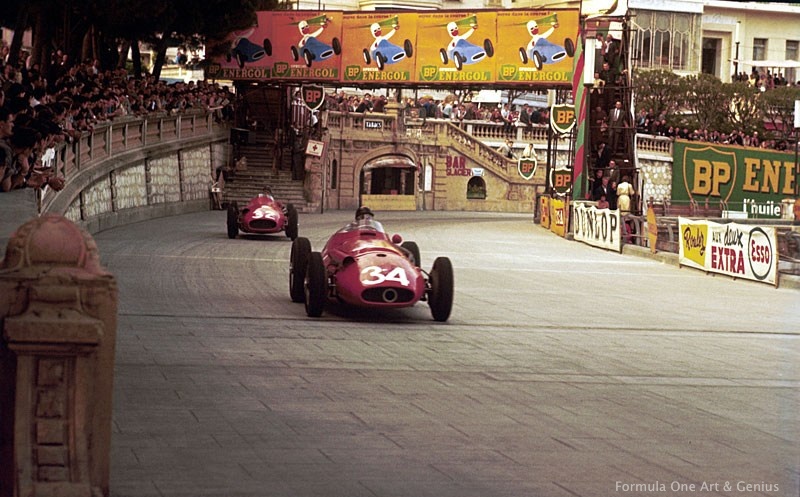 Nordeschlife (“North Ring”) by an amazing 12 seconds on three consecutive laps. He broke and re-broke the Ring lap record and when the Ferraris realized the danger, he was already in their mirrors. As the cars thundered past the South Curve, Fangio closed right up to Peter Collins’ gearbox and swept by with one wheel on the grass, peppering the Englishman with stones. It was the Argentine’s 24th and final Grand Prix victory, and also his most impressive. His last race was the Grand Prix of France at Reims in July 1958.
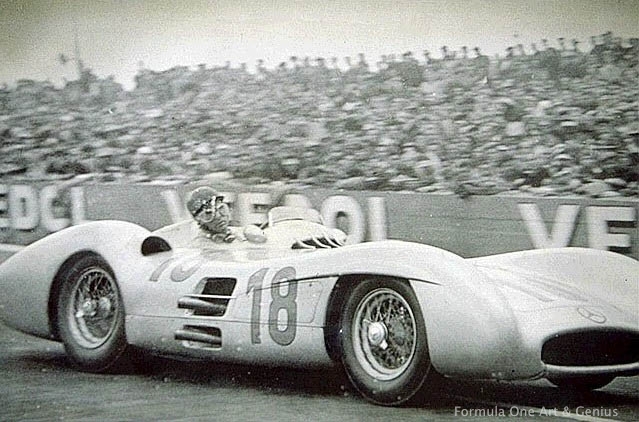
Fangio’s rival, erstwhile teammate and admirer was Stirling Moss — the greatest F1 driver never to win a championship — who finished second to Fangio at Mercedes in 1955 in the famous covered-wheel “Silver Arrows,” with Maserati in ’56 and then again with Vanwall in ’57. Moss became the first Briton to win the British Grand Prix, at Aintree in 1955, and the first to do so in a British car, the 1957 Vanwall VW5. After learning his craft in Fangio’s slipstream, Moss increasingly became the great Argentinian’s main rival. After Fangio retired, Moss took over the mantle of the best driver in the world, but his career declined, leading to retirement, following accidents during the 1960 Belgium Grand Prix at Spa-Francorchamps — where Moss was thrown from the car while navigating the intimidating “Masta Kink,” breaking both legs, after a rear axle broke at over 130 mph — and an even worse shunt at Goodwood in 1962.




It is unclear who wrote this article and when, I am using this article as a source in an essay and am finding it rather hard.
I wrote it and it is copyrighted. You can use it as a source but not republish.