
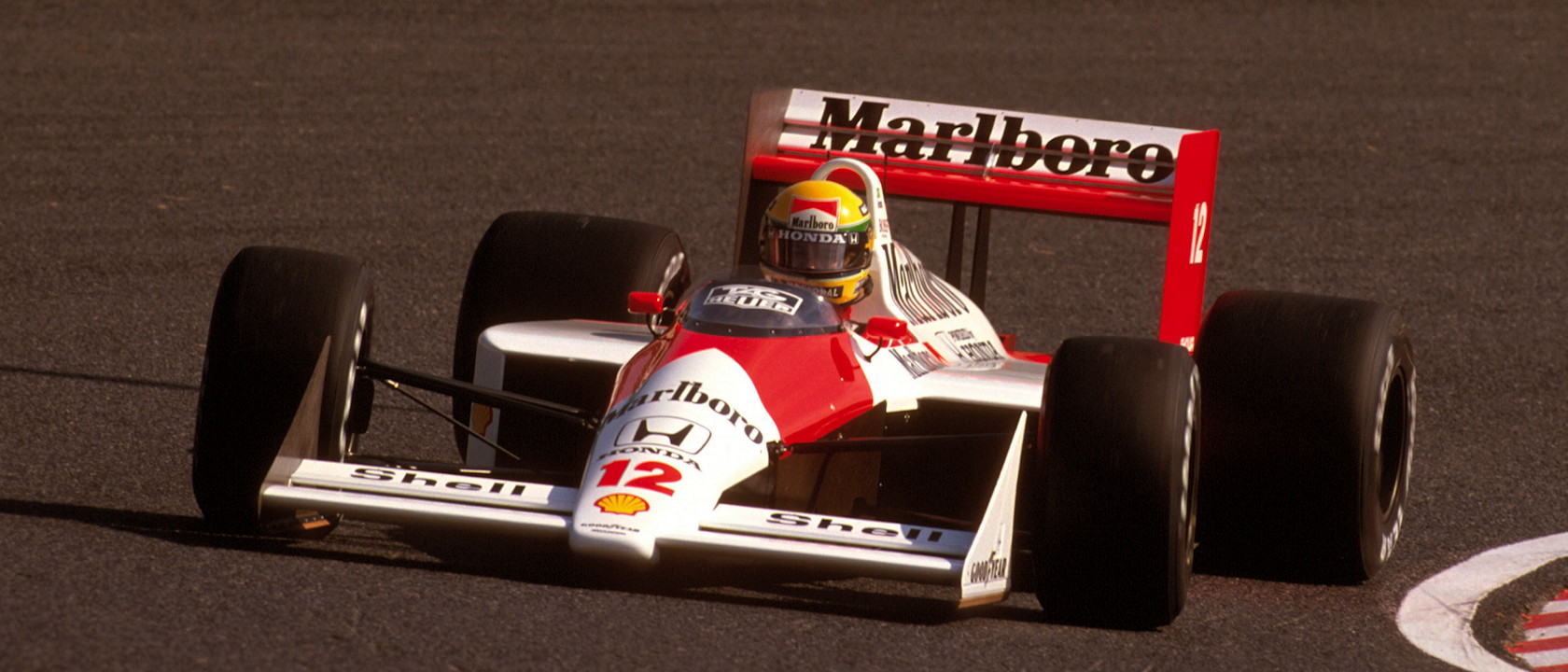
Senna’s Magnum Opus
Suzukua — 30 Oct. 1988
Ayrton Senna could clinch the World Driver’s Championship at Suzuka Circuit no matter what McLaren teammate Alain Prost did. This scenario was perfect for Senna. He seemed to be created for such a task — grab pole, go faster than anyone else, and win. The McLaren front row for the Japanese GP was the team’s remarkable 11th of the year, but its two drivers had far different fortunes at the start. Prost led off the grid from Gerhard Berger and Ivan Capelli. Pole-sitter (by 0.324s) Senna stalled; by the time the Honda engine in his MP4/13 restarted, he was left well back in 14th place. “It was the only start I missed all year, and it was the most important,” Senna would relate later. “When I dropped the clutch, the engine died, and then when I got it going, it did it again. I thought — ‘I am going to have to drive as hard as I can, but it will be impossible to catch Alain.’” The Brazilian nonetheless gained six places by lap two and then passed Riccardo Patrese, Thierry Boutsen, Alessandro Nannini and Michele Alboreto to take 4th place on lap four. On lap 14 the weather started to come into contention as rain began on parts of the circuit, benefitting Senna, who was particularly skilled in wet conditions. Capelli seized an historic chance on the following lap as his sea-green March-Judd nosed ahead of Prost to take the lead for one glorious moment in front of the pits,  the first time a non-turbo car had led a Grand Prix in more than four years. His limelight in P1 only lasted for a few hundred meters, however, as the extra power of the Honda turbo engine allowed Prost to regain the race lead going into the next corner.
 the first time a non-turbo car had led a Grand Prix in more than four years. His limelight in P1 only lasted for a few hundred meters, however, as the extra power of the Honda turbo engine allowed Prost to regain the race lead going into the next corner.
Alain Prost was indeed a potent and formidable adversary, not to be taken lightly. He had, after all, won two of the previous three World Championships and at that time had won more Grands Prix than anyone in history. Yet within another dozen tours, Senna was catching Prost rapidly, through traffic. On lap 27, as the duo attempted to lap Andrea de Cesaris, Satoru Nakajima and Maurício Gugelmin, Senna managed to force his way through as Prost was delayed by the Italian’s Rial. Commentator James Hunt famously called de Cesaris a “disgrace” for blocking Prost and publicly lambasted him during the BBC telecast for his driving. Senna then put in a succession of fast laps, breaking the track record and building a lead of more than three seconds. His 8th win of the year, by a margin of more than 13s, beat the F1 season record then held by Jim Clark and Prost, catapulting Senna to the 1st of his three World Championships. There was certainly no mistaking the elation that Senna felt as he crossed the line, punching the sky with both arms. Ayrton had pulled off the unimaginable with a stupefying performance. He won the Championship in the best possible fashion, beating the dominant driver of the day fair and square despite the huge obstacles that were thrown his way. After his victory at Estoril in 1985, Senna was given the nickname “Magic,” and at the Japanese Grand Prix in 1988 he proved how appropriate that nickname truly was. Classifications.
A featured race from the Six Best Comeback Drives | F1A&G collection.